Flexible Polyurethane Foam in Everyday Life: Applications, Demand Drivers, Market Impact and Output
Flexible polyurethane foam is a lightweight, highly elastic material made from the reaction of polyols and isocyanates. Its open-cell structure allows for easy compression and recovery, providing excellent cushioning and comfort. This material is commonly used in everyday products such as mattresses, sofas, automobile seating, carpet underlays, packaging, and medical supports. Its popularity stems from its softness, durability, resilience, and the ability to engineer it in a variety of densities, shapes, and firmness levels to meet specific requirements.
Flexible polyurethane foam is ideal for applications that require comfort, support, and shock absorption due to its low density and high resilience, making it a key material in both the consumer and industrial sectors.
Applications in Everyday Life
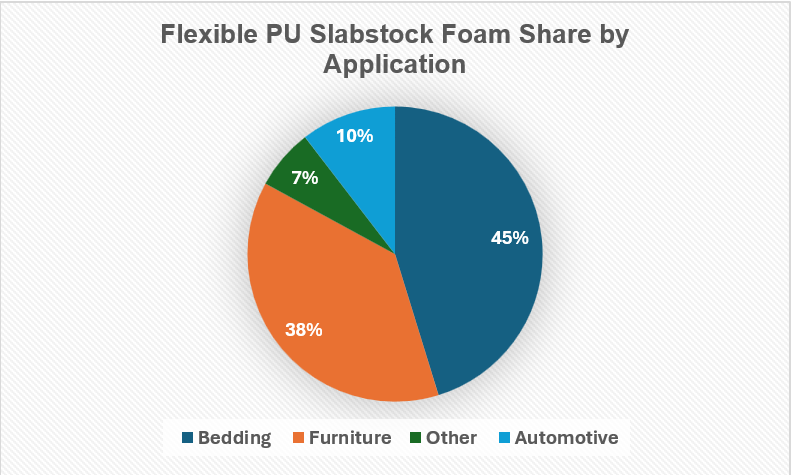
Flexible polyurethane foam plays a crucial role in the furniture and bedding industries, where it is widely used in products such as mattresses, pillows, sofas, recliners, and office chairs. Its popularity stems from its ability to deliver a high level of comfort, effective pressure distribution, and long-lasting performance. As consumers place greater emphasis on sleep quality and ergonomic living, flexible polyurethane foam has become an essential component in both everyday and premium home furnishings. Its properties such as density, firmness, and resilience can be customised to suit specific applications. In bedding and seating, high-resilience foam is commonly used in mattress cores, cushions, and pillows, offering durability and support that often surpass traditional materials. Memory foam, a specialised form of flexible polyurethane, enhances this further by moulding to the body’s shape, providing personalised comfort and improved pressure relief. Beyond domestic furniture, flexible polyurethane foam is also integral to seating design in settings such as cinemas and offices.
Automotive interiors are another major application area. Its ability to combine comfort with lightweight performance makes it particularly valuable as manufacturers aim to reduce vehicle weight, improve fuel efficiency, and extend the driving range of electric vehicles. The versatility of flexible polyurethane foam allows it to be applied across a wide range of functions, including seating systems, acoustic and vibration insulation, and impact protection. In seating design, it plays a central role in enhancing ergonomics. Beyond seating, flexible foams are used throughout the cabin to improve both functionality and aesthetics. Components such as dashboards, armrests, and interior panels often incorporate integral skin foam, which delivers a soft-touch, high-quality finish while also helping to absorb impact forces and improve passenger safety.
Flexible polyurethane foam is also highly valuable in healthcare and a range of support applications due to its unique ability to combine softness with structural support.
Beyond healthcare, the material has a wide presence in everyday and industrial uses. In packaging, it provides protective cushioning for delicate items such as electronics, medical equipment, and industrial machinery during transport, helping to prevent damage. In flooring, it is widely used as carpet underlay in both residential and commercial spaces, improving comfort underfoot while also enhancing insulation and reducing noise.
Demand drivers
Several key factors are driving long-term growth in demand for flexible polyurethane foam. Rising disposable incomes, particularly in emerging markets, are encouraging consumers to spend more on higher quality furniture, mattresses, and vehicles. At the same time, rapid urbanisation and increased housing development are boosting demand for household goods that rely heavily on foam cushioning. The automotive sector is another important contributor. As manufacturers focus on improving comfort while reducing vehicle weight, especially in electric vehicles, flexible foam is increasingly used in seating and interior components. It also supports quieter, more refined cabin environments.
Demographic trends further strengthen demand. An ageing population is increasing the need for healthcare and support products that provide comfort and pressure relief, while growth in the construction, hospitality, and retail sectors continues to expand its use in furnishings and interiors. In addition, rising awareness of sleep quality and wellbeing is driving the popularity of premium bedding, including memory and high-density foams. Broader trends such as population growth, e-commerce (increasing packaging needs), and advances in sustainable foam technologies are also contributing to the material’s expanding global demand.
Market impact and Outlook
Global production of flexible polyurethane foam is expected to grow at a compound annual growth rate (CAGR) of 3.3% until 2029. The Asia-Pacific region leads this growth, driven by strong manufacturing activity and increasing domestic demand, followed by EMEA and the Americas.
The Asia-Pacific region accounts for 43% of global flexible polyurethane foam production, a share projected to rise to 45% by 2029. This is followed by EMEA and the Americas, which contribute 32% and 25% of global production, respectively.

The flexible foam produced in Asia-Pacific is mainly slabstock foam, followed by transport and moulded foam, due to the large demand from the furniture and automotive industries. The production of flexible polyurethane foam for applications such as footwear and textiles, packaging, cosmetics, household items, toys, medical, sports, construction and other industries remains small. Demand and production of flexible slabstock are driven by the performance of the furniture and bedding industryand, ultimately, by real estate developments and consumer spending.
EMEA accounts for 78% of the flexible slabstock foam output and moulded foam for the remainder. The moulded (transport) segments fared slightly better than the slabstock (comfort) segments in 2024.
The flexible foam market in EMEA is relatively mature. Western Europe is the largest producer by some margin, followed by Eastern Europe, Africa and then Central Europe. Most countries are able to produce significant quantities of flexible slabstock since the production process is relatively simple; the moulded segment is more consolidated.
In America, slabstock accounts for the larger share of production at 74%, compared to moulded foam at 26%.
Flexible polyurethane foam has a wide-reaching impact across the value chain, driving demand for key raw materials such as polyols and isocyanates, as well as supporting industries including machinery, processing, and end-use sectors like furniture, automotive, and healthcare. Its influence extends beyond the material itself, creating significant value for suppliers, manufacturers, and logistics networks.
Despite its strong market position, the industry faces challenges such as fluctuations in raw material costs and increasing regulatory pressure on certain chemicals. However, ongoing innovation, particularly in sustainable formulations, recycling technologies, and advanced foams with added functionalities, continues to strengthen its outlook.
To learn more about our latest report on flexible foam, please follow the link below.
For more information, please contact ial@brggroup.com
IAL Consultants (A Division of BRG Enterprise Solutions Ltd)
CP House, 97-107 Uxbridge Road, Ealing, London W5 5TL
Tel: +44 (0) 20 8832 7780