
Thermoplastic Polyurethane: Global Production and Demand 2025
Summary:
In 2025, global thermoplastic polyurethane production increased by 9.1% to 1.16 million tonnes, while consumption grew by 5.7% to approximately 1.2 million tonnes, driven primarily by strong demand in Asia Pacific.
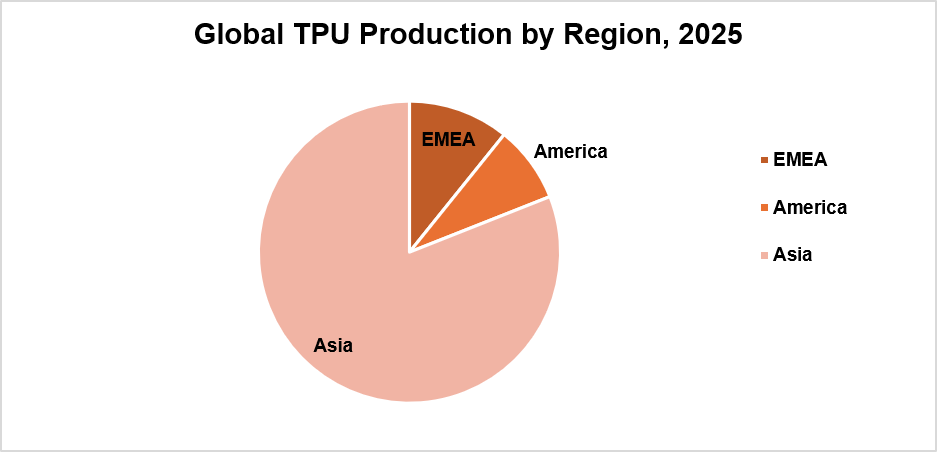
APAC remained the dominant production region, accounting for around 79% of global output, with China leading both production and consumption.
Footwear remained the largest end-use segment, representing 24.9% of total TPU consumption, followed by engineering and automotive applications.
Growing demand from electric vehicles, 3D printing, wearable electronics and consumer electronics supported market expansion and encouraged manufacturers to develop specialised, high-performance TPU grades.
Sustainability, improved material properties and technological advancements remained key innovation priorities, strengthening TPU's position across emerging industrial and high-value applications.
Global Outlook
In 2025, global thermoplastic polyurethane (TPU) production increased by 9.1% to approximately 1.16 million tonnes, driven primarily by strong growth in Asia Pacific (APAC), where production rose by 10.9%.
Extrusion and injection grades remained the dominant segments of the global TPU market, collectively accounting for more than 80% of total production.
Adhesives and coatings also recorded strong growth, while TPU used in 3D printing remained a niche segment, expanding by 10.1%, supported mainly by increasing adoption in robotics and industrial automation.

Compared with other segments of the polyurethane industry, the global TPU market demonstrated relative resilience to the economic downturn, experiencing a less pronounced impact from challenging economic conditions.
Source: IAL Consultants
Global TPU consumption reached approximately 1.2 million tonnes in 2025, representing growth of 5.7%, supported by recovering manufacturing activity and investment across APAC. Consumption of injection-grade TPU moderated following growth of 5.5% in 2025, whereas extrusion and 3D printing grades recorded increases of 7.0% and 4.8%, respectively.
China continued to lead the global thermoplastic polyurethane market in terms of both consumption and growth, driven by capacity investments, technological advancements and rising demand from footwear, electric vehicles (EVs), consumer electronics and industrial applications.
Asia Pacific remained by far the largest TPU-producing region globally, accounting for approximately 79% of total global TPU production in 2025. Western Europe retained its position as the second-largest producing region, followed by North America, while TPU production in other regions remained relatively limited.
Global Consumption of TPU by End-Use

Source: IAL Consultants
Footwear:
In 2025, footwear remained the largest end-use segment for TPU raw materials, accounting for approximately 24.9% of total consumption, followed by engineering and automotive applications.
According to the World Footwear Yearbook 2026, global footwear production remained broadly stable, increasing marginally by 0.1% to 24.6 billion pairs. Asia continued to dominate global footwear production, accounting for 88.7% of total output, with China, India and Vietnam representing shares of 55.6%, 12.2% and 6.7%, respectively.
Electronics:
The premium smartphone market continued to favour higher-priced devices, supporting demand for high-performance TPU in mobile accessories, particularly protective phone cases. TPU cases are increasingly gaining market share from silicone alternatives owing to their superior tear, impact, scratch and deformation resistance, alongside their non-slip surface properties.
In 2025, demand for TPU in printed electronics continued to increase, driven by the growing adoption of flexible and stretchable devices across smart textiles, wearable technology, healthcare and Internet of Things (IoT) applications.
Increasing competition from advanced thermoplastic elastomers (TPEs) and other high-performance polymers encouraged TPU manufacturers to accelerate product innovation, with a particular focus on improving processability, mechanical strength, durability and sustainability.
Manufacturers developed TPU grades offering enhanced elasticity, conductivity, chemical and hydrolysis resistance, UV stability, antimicrobial properties and wider operating temperature ranges.
In addition, next-generation formulations incorporating advanced additives, fibres and nanomaterials further improved abrasion resistance and thermal stability without compromising flexibility and toughness. These developments supported the wider adoption of TPU in electric vehicles, industrial automation, consumer electronics and advanced manufacturing.
EVs:
In 2025, continued growth in the electric vehicle (EV) sector created significant opportunities for the global TPU market. According to the International Energy Agency (IEA), global electric car sales were expected to exceed 20 million units in 2025, accounting for more than 25% of worldwide new car sales.
The expansion of the EV market supported demand for lightweight, durable and high-performance materials, creating opportunities for TPU in flexible tubing, wire and cable insulation, interior components, battery protection systems, seals, gaskets and advanced 3D-printed automotive components.
Conclusion
The global TPU market is expected to maintain steady growth, supported by expanding applications across footwear, automotive, electric vehicles, consumer electronics and additive manufacturing. Asia Pacific, particularly China, will remain the key growth engine owing to its strong manufacturing base and increasing consumption. Going forward, innovation in sustainable, bio-attributed and application-specific TPU grades, alongside improvements in thermal resistance, durability and processability, will create new opportunities for manufacturers.
Author: Agrim Thapliyal
Source: IAL Consultants
To learn more about the report, please see the link below:
For more information, please contact:
IAL Consultants
CP House, 97107 Uxbridge Road
Ealing
London W5 5TL
Telephone: +44 20 8832 7780
Email: ial@brggroup.com
Or visit our website: www.ialconsultants.com


