
GLOBAL OVERVIEW OF THE THERMOPLASTIC POLYURETHANE (TPU) MARKET
IAL Consultants has recently published the Tenth edition of its popular report entitled Global Overview of the Thermoplastic Polyurethane Market.
This new study examines the national, regional and global markets for thermoplastic polyurethanes for 2025 and bui on the research from our previous editions. It explores the market trends driving TPU production and subsequent demand, provides an indication of raw material consumption, and also presents future growth opportunities in the TPU market. Five-year market forecasts to 2030 are also included.

In 2025, global TPU production grew by 9.1% to approximately 1.16 million tonnes, driven primarily by APAC, which recorded growth of 10.9%. Extrusion and injection remained the dominant segments, collectively accounting for more than 80% of total production. Adhesives and coatings also recorded strong growth, while 3D printing remained a niche segment, expanding by 10.1%, supported mainly by increasing adoption in robotics and industrial automation.
The TPU market has not been less severely affected by the economic crisis compared to other segments within the polyurethanes industry.
Source: IAL Consultants
Global TPU consumption reached 1.2 million tonnes in 2025, growing by 5.7%, supported by recovering production and investment across APAC. Injection-grade consumption growth moderated following a 5.5% increase in 2024, while extrusion and 3D printing grew by 7.0% and 4.8%, respectively. China continued to lead the global TPU market in both consumption and growth, driven by capacity investments, technological advancements and rising demand from footwear, EVs, consumer electronics and industrial applications.
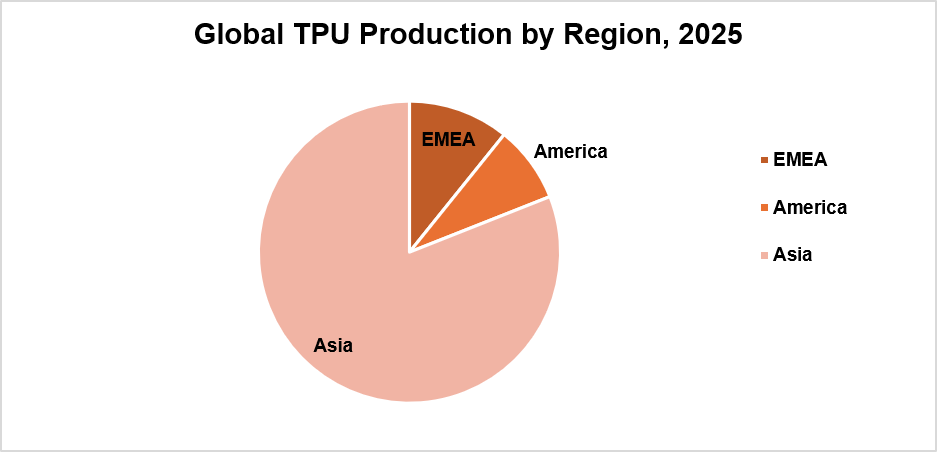
Asia Pacific remains by far the biggest TPU producer globally, with 79% of global production taking place in this region. Western Europe remains the second largest producing region, followed by North America. The production in other regions remain limited.
In 2025, aromatic TPU accounted for around 78% of production, while aliphatic TPU represented approximately 22%. Aromatic TPU remained dominant due to its cost-effectiveness, mechanical strength, abrasion resistance and ease of processing, with broad use across footwear, automotive, industrial and wire and cable applications. Aliphatic TPU continued to gain traction in high-value applications requiring UV resistance, colour stability and weatherability, including PPF, automotive films, medical devices, wearable electronics and specialty coatings. Producers such as Covestro and Lubrizol are expanding aliphatic TPU portfolios, including sustainable and bio-attributed grades, to meet growing performance and environmental requirements.

Source: IAL Consultants
The TPU converter market is highly fragmented, comprising a large number of small and medium-sized companies that manufacture customised products for a wide range of end-use applications. Many of these converters source raw materials through PU systems houses and distributors, making it challenging to accurately estimate overall product output and raw material demand, despite the majority of raw materials being manufactured by a relatively limited number of suppliers.
TPU can be tailored for a wide range of applications by varying the chemical additive packages used. Flame-retardant grades can be developed for electrical cables, although improving temperature resistance remains a key challenge for research and development teams. Antistatic grades are also available for electrical applications and specialised industrial footwear. When reinforced with glass fibres and/or mineral fillers, TPU can be used as a paintable structural engineering material. This versatility enables TPU to function as a hard rubber in wheels and rollers or as a soft plastic for coating applications.
In 2025, innovation remained a key growth driver for the thermoplastic polyurethane (TPU) industry, with producers increasing investment in research and development to expand their portfolios of specialised grades and enhance material performance. Demand for application-specific TPU solutions continued to grow, particularly in additive manufacturing, where flexibility, durability, abrasion resistance and design freedom are highly valued.
The use of TPU in 3D printing continued to gain momentum across a wide range of applications, including automotive components, medical devices, footwear, industrial parts and consumer products. Major TPU manufacturers expanded their additive manufacturing portfolios, offering dedicated TPU filaments and powders for extrusion-based printing, Selective Laser Sintering (SLS), Powder Bed Fusion (PBF) and Multi Jet Fusion (MJF) technologies. These materials enable the production of lightweight, flexible and customised components with complex geometries that are difficult to achieve using conventional manufacturing methods.
Advances in additive manufacturing technologies have further improved the processing and performance of TPU materials. Modern 3D printing processes enable manufacturers to produce durable components with excellent elasticity, impact resistance and mechanical strength while reducing material waste. TPU’s combination of flexibility and high-performance properties has strengthened its adoption as an elastomeric material in additive manufacturing. As 3D printing capabilities continue to advance, TPU is expected to see wider adoption in both prototyping and end-use applications, particularly for customised, low-volume and high-value components.
In 2025, footwear remained the largest end-use segment for TPU raw materials, accounting for approximately 24.9% of total consumption followed by engineering and automotive. According to the World Footwear Yearbook 2026, global footwear production remained largely stable, increasing by 0.1% to 24.6 billion pairs. Asia continued to dominate production, accounting for 88.7% of global output, led by China, India and Vietnam, with shares of 55.6%, 12.2% and 6.7%, respectively. The strong concentration of footwear manufacturing in Asia continued to support demand for TPU in footwear applications.

Source: IAL Consultants
The premium smartphone market continued to favour higher-priced devices, supporting demand for high-performance TPU in mobile accessories, particularly phone cases. TPU cases are gaining share from silicone due to their excellent tear, impact, scratch and deformation resistance, along with their non-slip feel, attracting further investment from producers.
In 2025, TPU demand in printed electronics continued to grow, driven by the adoption of flexible and stretchable devices in smart textiles, wearables, healthcare and IoT applications. TPU films offer flexibility, elasticity and durability, making them suitable for printed circuits and sensors, while advances in processing and conductive materials have improved printability and performance under repeated bending.
The growing competition from advanced thermoplastic elastomers (TPEs) and other high-performance polymers encouraged TPU producers to accelerate innovation, focusing on improved processing, mechanical strength, durability and sustainability. Manufacturers developed grades with enhanced elasticity, conductivity, chemical and hydrolysis resistance, UV stability, antimicrobial properties and wider operating temperature ranges, while next-generation formulations incorporating advanced additives, fibres and nanomaterials further improved abrasion resistance and thermal stability without compromising flexibility and toughness. These developments supported wider TPU adoption in electric vehicles, industrial automation, consumer electronics and advanced manufacturing.
In 2025, strong growth in the electric vehicle (EV) sector continued to create significant opportunities for thermoplastic polyurethane (TPU). According to the International Energy Agency (IEA), global electric car sales were expected to exceed 20 million units in 2025, accounting for more than 25% of new car sales worldwide. The continued expansion of the EV market supported demand for lightweight, durable and high-performance materials, driving TPU applications in flexible tubing, wire and cable insulation, interior components, battery protection systems, seals, gaskets and advanced 3D-printed automotive components. Ongoing investment in dedicated EV manufacturing facilities and automation further supported TPU demand across the automotive value chain.
Global Overview of the Thermoplastic Polyurethane Market is now available from IAL Consultants, priced at €5,500.
For more information please contact:
IAL Consultants
CP House, 97107 Uxbridge Road
Ealing
London W5 5TL
Telephone: +44 20 8832 7780
Email: ial@brggroup.com
Or visit our website: www.ialconsultants.com


