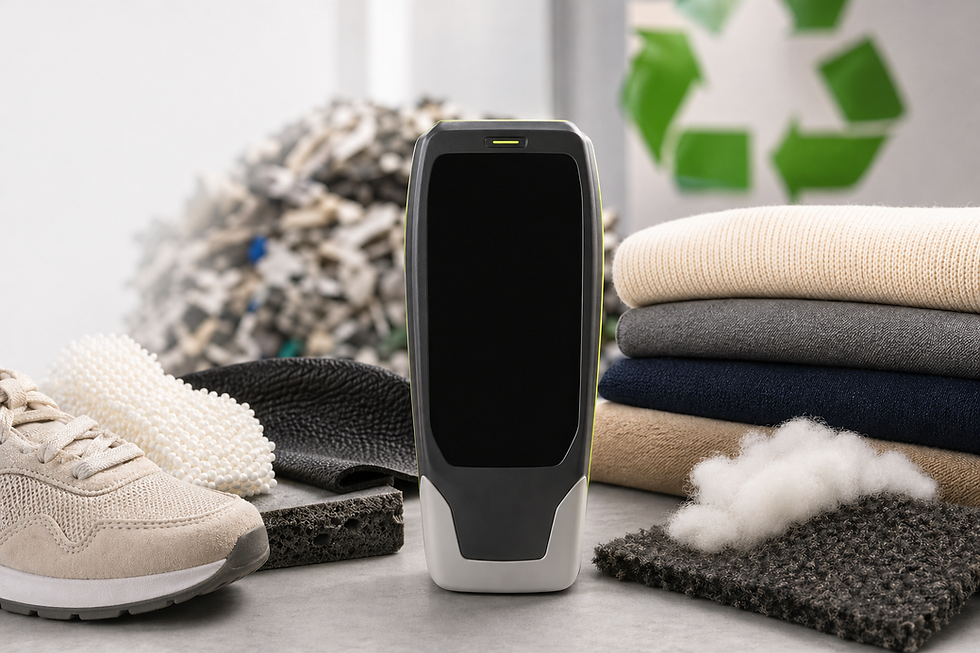
trinamiX expands mobile NIR spectroscopy applications for the footwear and textile industries.
trinamiX GmbH has expanded its portfolio of solutions for the circular economy, now enabling the identification of materials used in the footwear and textile industries. The company uses its mobile near-infrared (NIR) spectroscopy solutions to help manufacturers, sorters, recyclers, and brand owners accurately identify materials and improve transparency in increasingly complex value chains.
Modern footwear and textiles are composed of complex material combinations and blended structures, making visual inspection insufficient for accurately determining material composition. At the same time, increasing regulatory requirements and sustainability targets are driving the need for reliable and traceable material data.
“Material innovation is driving the future of footwear and textiles, but it also increases complexity across the value chain,” said Adrian Vogel, Segment Lead Circular Economy at trinamiX. “trinamiX Mobile NIR Spectroscopy Solution provides a practical tool that helps customers gain transparency, minimize risks, and enable informed decisions in recycling and circular economy processes.”
Reliable Shoe Component Identification
Footwear products today are composed of multiple components made from various polymers, foams, textiles, and composite materials. trinamiX’s mobile NIR spectroscopy solution lets you quickly and reliably identify common materials like EVA, polyester, and PU right on site. Measurements can be conducted during incoming goods inspection, throughout production, and in sorting or recycling processes. This enhances material separation, improves quality control, and supports recycling readiness, while reducing contamination risks and manual sorting efforts.
Enhancing Transparency Across Textile Value Chains
Similar challenges are evident in the textile industry, where blended fabrics present significant barriers to recycling and reuse. trinamiX’s solution enables the identification of key textile materials and their blends, such as cotton/polyester and viscose/polyester. For binary blends, fibre compositions can be quantified as percentages, while more complex material structures can be reliably analysed and assessed.
The textile application, available from May 2026, helps textile producers, brands, sorters, recyclers, and carpet manufacturers check material declarations, improve sorting accuracy, and support closed-loop recycling.
Integrated Handheld Solution for Decentralized Applications
trinamiX enables material identification at the push of a button through an integrated solution that combines a robust handheld spectrometer, an intuitive mobile app, and a cloud-based data platform. The TrinamiX PAL Two spectrometer delivers fast, non-destructive measurements, even in demanding environments. The mobile app guides users through the process and provides instant, easy-to-interpret results, while the customer portal ensures secure documentation, visualisation, and traceability of data. This integrated ecosystem offers reproducible results, minimal training requirements, and standardised material identification across multiple sites and regions.
Furthermore, the trinamiX ecosystem can be easily integrated into existing software systems using APIs, allowing advanced data processing that meets regulatory frameworks like Digital Product Passports (DPP) and sustainability performance metrics.
Source: trinamiX