Polyurethane in Cold Chain Appliances: Insulating the Future
Polyurethane is a versatile polymer that plays an important role in cold chain appliances. It helps to keep products safe and fresh and to conserve energy during storage and transportation. Rigid polyurethane foam is commonly used as an insulator in appliances to reduce food waste and increase the shelf life of perishable goods. One of its primary applications is as an insulating material in refrigerators and freezers. Polyurethane provides excellent thermal insulation, allowing appliances to operate at low temperatures while using less energy. Simultaneously, it provides strong structural support and manufacturing flexibility, allowing for more efficient space use than traditional insulation materials. Overall, polyurethane has become an important material in cold chain appliances due to its ability to combine high performance, durability and energy efficiency in a single system.
Role in Cold Chain Systems
Cold chain appliances are used to store and transport temperature-sensitive products, such as food, drinks, vaccines and medicines. Rigid polyurethane foam is widely used as the main insulating material in these systems. Its closed-cell structure helps to minimise heat transfer, ensuring stable internal temperature and maintain product quality. Although polyurethane remains the dominant material in appliances, it is facing competition from higher-performance alternatives such as VIPs (vacuum insulation panels) and aerogels. However, polyurethane is still widely used because it is cost effective, more durable and easier to manufacture.
Industry Outlook
Polyurethane is experiencing strong and consistent growth in demand within the cold chain sector, owing to a combination of economic, regulatory and consumer-related factors. Increasingly stringent government regulations on energy efficiency are encouraging the use of advanced materials in appliances. Polyurethane insulation can help reduce electricity consumption in refrigeration systems, resulting in lower operating costs and lower carbon emissions.
IAL’s EMEA refrigeration rigid foam production data for 2025 has recently been updated, while the other regions reflect findings from the previous year’s reports (2024).
EMEA
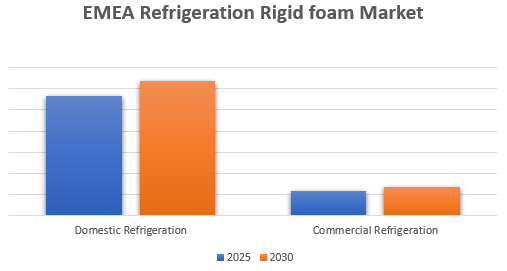
In 2025, refrigeration rigid foam production in the EMEA region was estimated to be around 0.34 million tonnes, with domestic refrigeration accounting for 83% of total production and commercial refrigeration accounting for the remaining 17%. According to IAL projections, the market will expand at a compound annual growth rate (CAGR) of 2.5% between 2025 and 2030, as it has already reached a high level of maturity.
APAC

The APAC region is the largest producer of refrigeration rigid foam, with production around 1.41 million tonnes in 2024. domestic refrigeration accounts for 85% of total production and commercial refrigeration for the remaining 15%. Output is forecast to expand at a compound annual growth rate (CAGR) of 5.2% between 2024 and 2029.
Asia is a global manufacturing hub for refrigeration equipment, producing the vast majority of the world's refrigerators and cold chain appliances. China leads refrigerator production in Asia, with around 97.7 million units produced in 2024. Growth was mainly driven by household demand, supported by government incentives, new product launches, and a trend towards larger-capacity appliances.
Americas

Refrigeration rigid foam production in the Americas region was estimated to be around 0.35 million tonnes in 2024, with domestic refrigeration accounting for 87% of total production and commercial refrigeration accounting for the remaining 13%. According to IAL projections, the market will expand at a compound annual growth rate (CAGR) of 3.0% between 2024 and 2029.
The cold chain appliance industry uses rigid polyurethane foam for its thermal insulation, low water permeability and structural rigidity in refrigerators, freezers, combined units and refrigerated transportation.
Source: IAL Consultants
EMEA data with the base year 2025 is out. To learn more about the report, please follow the link:
For more details, please contact: IAL Consultants
Email: ial@brggroup.com
Or visit our website: www.ialconsultants.com