Middle East Construction Boom and its Impact on Polyurethane Demand
The Middle East construction sector expanded in 2025, led by Saudi Arabia and the UAE, with ongoing investment in residential, hospitality, healthcare, infrastructure and industrial developments. Saudi Arabia remains a key construction hub under Vision 2030, with over 5,200 ongoing projects worth more than US$819 billion. Major gigaprojects such as NEOM, the Red Sea Project, Qiddiya and Diriyah have continued to boost construction activity and demand for building materials.
Construction growth in the UAE is bolstered by government-backed housing programmes, infrastructure investment, commercial development and residential demand. The Sheikh Zayed Housing Program accepted 2,971 housing applications from January to September 2025, while Abu Dhabi had roughly 33,074 residential units under development or scheduled for delivery by 2029. Additionally, 12,309 buildings were finished in Abu Dhabi during the first half of 2025. Upcoming initiatives related to the FIFA World Cup 2034, Expo 2030 Riyadh and Dubai 2040 are likely to further boost demand for PU insulation, adhesives, sealants and coatings.
Construction Growth Supports Polyurethane Demand
Increased construction activity is driving up demand for polyurethane (PU) rigid foams, spray polyurethane foam (SPF), adhesives, sealants and coatings. PU is ideal for construction applications due to its thermal insulation, moisture resistance, lightweight properties and durability.
According to IAL Consultants, the Middle East polyurethane industry is predicted to expand at a rate of 4.8% through 2030. Saudi Arabia is likely to be the fastest growing major market, with PU demand rising by roughly 8.2% by 2030, while the UAE market is expected to grow by around 5.7%.

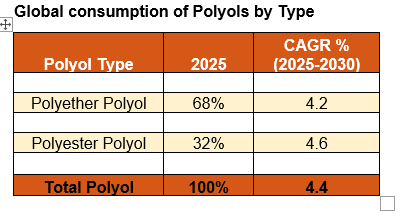
Figure1: The figure shows the predicted growth of polyurethane production across the Middle East from 2025 to 2030.
Rigid PU Foam Gains Importance in Building Insulation
Thermal Insulation for Buildings
Rigid PU and PIR foams are rapidly being used in roofs, exterior walls, floors, facades and insulated sandwich panels. Their low thermal conductivity allows for strong insulation performance with very thin material layers, making them ideal for the Middle East's hot environment and significant cooling requirements.
These materials are generally applicable in commercial buildings, warehouses, cold storage facilities, industrial facilities and residential communities. PU/PIR sandwich panels also contribute to the expansion of logistics and industrial infrastructure by combining insulation and quick installation.
According to IAL Consultants, the Middle East rigid PU foam production increased by roughly 4% per annum in 2025. Saudi Arabia, the UAE and Iran remained the largest producing markets, with Saudi Arabia and other GCC markets recording the most growth.
SPF offers an extra option, particularly for roof restoration, irregular surfaces and regions where traditional insulation boards are difficult to install. According to IAL Consultants, Middle East SPF production is expected to increase by about 6% by 2030.
The region's rising emphasis on energy efficiency and lower building operating costs is likely to boost demand for high-performance insulation. Saudi Arabia and the UAE have also set long-term net-zero targets, with an emphasis on energy-efficient building technologies.
Adhesives and Sealants
Construction development is also driving up demand for PU adhesives and sealants, which are utilised in insulation panels, flooring, roofing, façades and other construction components. Their excellent adhesion, elasticity and moisture resistance make them ideal for harsh climatic situations. IAL Consultants predicts that Middle Eastern PU adhesive production will expand by about 2% by 2030, while PU construction adhesive production is likely to expand by 3.4% throughout the forecast period.
Coatings
In the Middle East, polyurethane coatings are vital for keeping multibillion-dollar infrastructure safe from UV radiation, high salt levels, and sudden changes in temperature. Demand for polyurethane coatings is expected to increase due to the region's expanding infrastructure and building pipeline. The Middle Eastern PU construction coatings industry is expected to expand by around 6% between 2025 and 2030, according to IAL Consultants.
Outlook for 2026 and Beyond
The escalation of the Middle East crisis in early 2026 has created more uncertainty. Disruptions to energy infrastructure, oil and LNG exports, and shipping across the Strait of Hormuz have driven up energy, logistical and construction costs. These issues may cause project delays and put pressure on construction margins, but significant government-backed ventures will continue to generate underlying demand.
Overall, the Middle Eastern construction boom is projected to be a major driver of PU consumption. Rising energy efficiency and sustainability regulations will drive up demand for PU insulation, adhesives, sealants and coatings throughout the region.

Author: Noor E. Shama
Source: IAL Consultants
EMEA data with the base year 2025 is out. To learn more about the report, please follow the link:
For more details, please contact: IAL Consultants
Email: ial@brggroup.com
Or visit our website: www.ialconsultants.com