Polyol Market Set for Steady Growth as Construction and Automotive Demand Accelerate
Polyols are one of the key raw materials used in the manufacture of polyurethane and play a vital role in determining the performance characteristics of the final product. Together with isocyanates and additives, they form polyurethane materials used across a wide range of applications, including insulation, furniture, automotive components, construction products, and appliances. The two main categories of polyols are polyether polyols and polyester polyols. Polyether polyols are widely used in the production of flexible polyurethane foams due to their excellent flexibility, resilience, and cost-effectiveness. In contrast, polyester polyols offer enhanced strength, durability, and chemical resistance, making them particularly suitable for rigid polyurethane foams and other high-performance applications. The chemical composition and molecular weight of the polyol significantly influence key properties such as flexibility, rigidity, thermal insulation, and durability, enabling manufacturers to tailor polyurethane products to specific end-use requirements.

Source: IAL Consultants
In 2025, global polyol consumption across all end-use segments was estimated at approximately 9.0 million tonnes. Demand is projected to increase to around 11.0 million tonnes by 2030, representing a compound annual growth rate (CAGR) of 4.4% over the 2025-2030 forecast period. Growth is expected to be primarily supported by rising consumption in the construction sector, particularly for insulation and building applications, as well as increasing demand from the automotive industry for lightweight and comfort-enhancing polyurethane components.
Polyether polyol represents the larger share of the market, accounting for 68%, while polyester polyol contributes the remaining 32%. Both product types are expected to grow between 2025 and 2030, with polyester polyol recording a slightly higher CAGR of 4.6%, compared with 4.2% for polyether polyol.
Polyether Polyols
Source: IAL Consultants
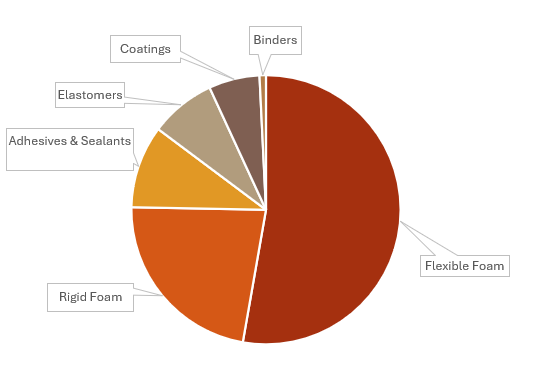
Polyether polyol global consumption by product type reached 6.0 million tonnes in 2025, with the main end-use in flexible foam applications, which represented around 53% of the total consumption. Flexible foam is expected to remain the dominant application segment and is projected to record the highest growth rate, at a CAGR of 4.5% over the forecast period. Demand for polyether polyols within this segment is closely linked to the performance of the automotive industry, where flexible polyurethane foams are extensively used in seating systems, noise, vibration and harshness (NVH) insulation, carpet backing, and a range of interior comfort components. In particular moulded flexible foams represent a significant share of polyether polyol consumption, owing to their widespread use in automotive seats and interior cushioning applications.
Rigid foam applications accounted for approximately 23% of global polyether polyol consumption in 2025, making them the second-largest end-use segment after flexible foam. Demand is predominantly driven by the construction industry, where polyurethane rigid foams are widely utilised for their excellent thermal insulation, lightweight characteristics, and structural strength.
Polyether polyols play a critical role in the production of rigid polyurethane panels, insulation boards, and sprayed polyurethane foam (SPF), all of which are essential materials for improving building energy efficiency and meeting increasingly stringent insulation standards. As investment in residential, commercial, and industrial construction continues, alongside growing refurbishment activity and the transition towards more energy-efficient buildings, demand for rigid polyurethane foams is expected to strengthen. Consequently, the construction sector is projected to remain the primary driver of polyether polyol consumption in rigid foam applications over the forecast period. The construction sector covers over 80.0% of PU rigid foam used in the EMEA region, with additional demand coming from the cold chain and refrigeration industries. By product type, the single largest category is rigid-faced panels, followed by flexible-faced panels, refrigeration foam and OCF.
Polyester Polyols
Source: IAL Consultants
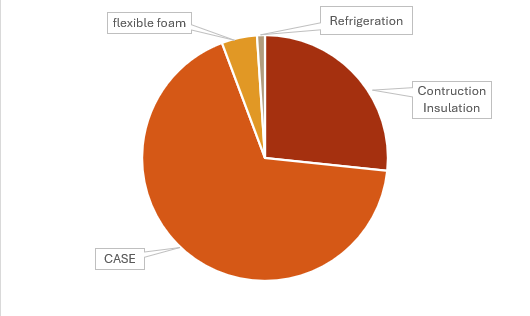
In 2025, global polyester polyol consumption was estimated at approximately 3.0 million tonnes. Demand was predominantly driven by CASE applications, which accounted for nearly 68% of total consumption, highlighting the material's extensive use in high-performance coatings, adhesives, sealants and elastomers. The construction insulation sector represented the second-largest end-use, contributing around 27% of global demand. From a product perspective, the polyester polyol market is broadly segmented into aromatic polyester polyols and aliphatic polyester polyols, each serving distinct performance and application requirements.
Aromatic polyester polyols in polyurethane applications amounted to approximately 0.8 million tonnes. Demand is forecast to grow steadily to around 1.10 million tonnes by 2030, representing an average annual growth rate of 4.6%. Growth is primarily driven by expanding insulation demand, infrastructure development and rising use of rigid polyurethane systems, particularly in energy-efficient construction and industrial applications. Regional growth patterns vary significantly, reflecting differences in construction activity, regulatory frameworks and industrial maturity. The demand for aromatic polyester polyols is predominantly linked to the production of polyurethane rigid foam insulation (including refrigeration). Increasingly, the global market is driven by performance, legislation and higher fire-rated product requirements, for which aromatic polyester polyols are a crucial component. The majority of aromatic polyester polyols being used in rigid foam applications, with the Americas experiencing the most demand, followed by EMEA and APAC.
Global consumption of aliphatic polyester reached approximately 1.9 million tonnes in 2025, with flexible foam applications 0.1 million tonnes reflecting the niche but technically important role of polyester polyols within the broader polyurethane foam market. Demand was heavily concentrated in Asia-Pacific, underpinned by strong activity in furniture, bedding, textiles and automotive interior components. Within EMEA, Western Europe represented the largest market, supported by established automotive and industrial supply chains. North America remained a significant but comparatively smaller market, while volumes in Central and Eastern Europe, Latin America, the Middle East and Africa were constrained by more limited production capacity and cost sensitivity.
The automotive and construction sectors are key drivers of aliphatic polyester polyol demand, primarily through their use in adhesives, sealants and coatings. Adhesives and sealants accounted for 9% of total consumption of aliphatic polyester polyol, supported by vehicle production across passenger cars, commercial vehicles, buses, trucks, trailers, recreational vehicles and marine vessels. PU adhesives are widely used for bonding structural and interior components, including walls, aluminium surfaces, dashboards and trim, helping manufacturers reduce assembly steps, labour requirements and production costs.
PU coatings represented 18% of total consumption and are among the most stable polyurethane end-use segments. Demand is underpinned by the need for durable surface protection, corrosion resistance and aesthetic performance across transport and construction applications. Continued requirements for automotive refinishing, corrosion protection and building materials support steady consumption.
Author: Manmohan Singh
Source: IAL Consultants
For more information, please contact:
IAL Consultants
CP House, 97107 Uxbridge Road
Ealing, London W5 5TL
Telephone: +44 (0) 20 8832 7780
Email: ial@brggroup.com
Or visit our website: www.ialconsultants.com